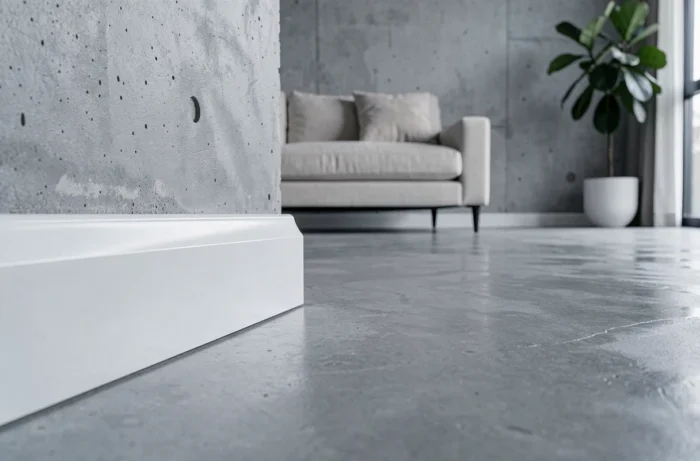
Polished concrete is appealing due to its monolithic appearance, this smooth and continuous surface that provides an uninterrupted reading of a room. Installing a baseboard on this type of flooring introduces a deliberate visual break, and the choice of material, profile, and fixing technique determines the final result as much as the covering itself.
Concrete substrate moisture: the parameter that the baseboard will not hide
Before choosing a baseboard, it is essential to check the condition of the substrate. The DTU 54.1 on resin systems requires measuring the residual moisture of the slab and that of the ambient air separately. A polished concrete laid on a too-humid screed risks blistering or detaching, particularly at the baseboards and wall footings.
This point is often overlooked when selecting finishes. A baseboard glued to a wall whose base remains damp will eventually come off, regardless of its material. Measuring moisture with a carbide bomb before any finishing installation remains the reference method.
On the ground floor, the DTU 20.1 imposes a minimum ground clearance of 5 cm above the finished exterior level and a waterproofing rise of at least 15 cm. These constraints directly influence the height and type of baseboard that can be considered, especially in humid areas like the bathroom or kitchen.
Asking which baseboard with polished concrete is best suited therefore assumes that this moisture issue has been addressed first; otherwise, the aesthetic result will be compromised within a few months.
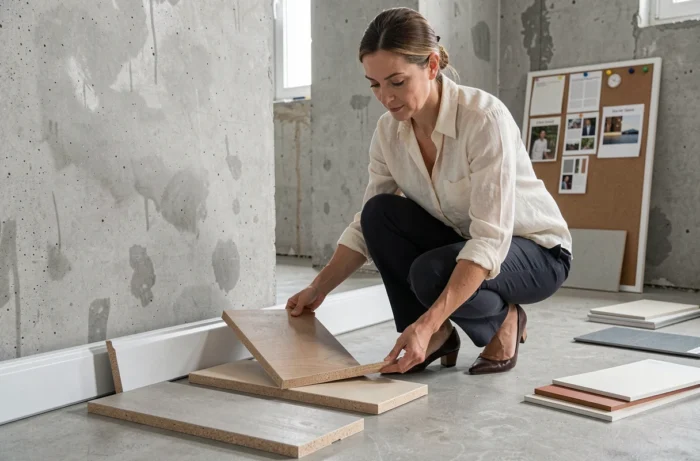
MDF, PVC, or aluminum baseboards: comparison for polished concrete
Three families of materials consistently appear in polished concrete flooring projects. Each presents distinct characteristics in terms of visual rendering, resistance, and installation method.
Painted or coated MDF baseboard
MDF offers a regular profile and lends itself to a lacquered finish that can match the tone of polished concrete. Its cost remains moderate. However, MDF does not handle prolonged moisture well: in a bathroom or laundry room, it swells at the base and warps. Its use is therefore limited to dry rooms (living room, bedroom, hallway).
Flexible or rigid PVC baseboard
PVC is water-resistant and cuts easily. Rigid models now imitate various textures, including the appearance of concrete. Flexible models conform to the irregularities of the wall, which can be an advantage on old partitions. A common complaint concerns the rendering: PVC retains a plastic appearance that polished concrete, a raw material by nature, can make even more visible.
Aluminum or stainless steel baseboard
Brushed or anodized aluminum creates a clean and discreet junction with a polished concrete floor. Its thin profile (often less than one centimeter thick) limits the protrusion on the wall. It is moisture-resistant, easy to clean, and does not warp. It is the material that integrates most naturally into the mineral aesthetic of polished concrete, especially in kitchens and bathrooms.
The table below summarizes the comparison points:
| Material | Moisture resistance | Rendering with polished concrete | Suitable rooms |
|---|---|---|---|
| MDF | Low | Acceptable if lacquered | Living room, bedroom |
| PVC | Good | Visible plastic appearance | All rooms |
| Aluminum | Excellent | Discreet, coherent | All rooms, including bathroom |
Fixing technique on wall with polished concrete floor: glue or clip
The installation method depends on the material of the baseboard, but also on the nature of the wall and the thickness of the polished concrete on the floor.
- Gluing (polyurethane adhesive or MS polymer) is suitable for aluminum and MDF baseboards on flat walls. It avoids drilling and preserves the waterproofing of the wall base, a critical point in humid rooms.
- Clipping works with certain PVC or MDF baseboards equipped with a fixing rail. It allows for later disassembly without damage, but the rail adds a few millimeters of thickness to the wall.
- Screwing is reserved for solid wood baseboards or contexts where gluing does not hold (crumbly plastered walls, irregular surfaces). Screw heads must be countersunk and then filled for a clean finish.
Regardless of the fixing method, the baseboard should never press directly against the polished concrete. A gap of a few millimeters at the base of the baseboard allows the covering to move without constraint. This gap is then filled with a matching flexible joint, either silicone or acrylic depending on the room.
Polished concrete baseboard: the false good idea and its limits
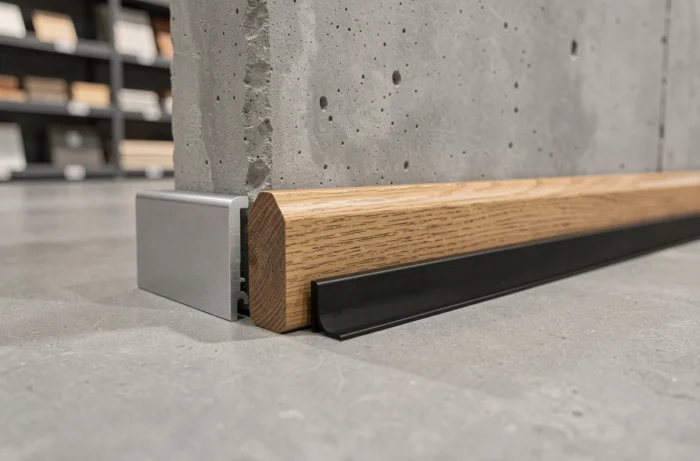
Extending the polished concrete from the floor up to the bottom of the wall to create an integrated baseboard seems logical. The monolithic rendering achieved is indeed striking. Field feedback varies on this point: some applicators report satisfactory durability over several years, while others observe micro-cracks at the floor-wall junction, where structural movements concentrate.
The technical difficulty lies in preparing the vertical substrate. Polished concrete adheres well to a properly primed horizontal screed, but the adhesion on a plaster or gypsum board wall requires a specific primer and a controlled layer thickness. If too thin, the coating cracks. If too thick, it runs before drying.
In a bathroom, this option also requires complete waterproofing treatment of the rise, which increases the workload and budget. For a kitchen or living room, the polished concrete baseboard can work if the applicator masters the technique, but one must accept that the maintenance of a polished concrete baseboard requires the same care as the floor: periodic protective waxing, cleaning without acidic products.
The choice of a baseboard for a polished concrete floor therefore hinges on three concrete parameters: the actual moisture of the substrate and the room, the material that can withstand these conditions, and the fixing technique that preserves the necessary gap for the covering. Starting from the floor and moving up to the wall, in that order, avoids most of the issues observed after installation.