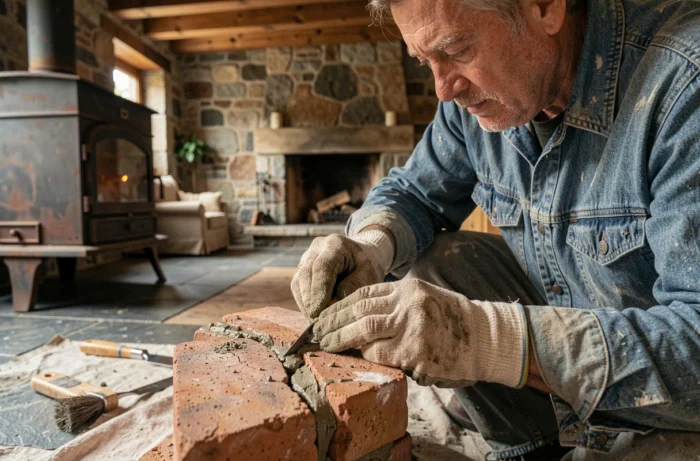
A crack in a refractory brick does not mean that your wood stove is at the end of its life. In most cases, this type of damage can be repaired with the right material and a bit of method. Understanding why these cracks appear mainly helps to prevent them from returning too quickly and to truly extend the lifespan of your heating appliance.
Cracks in refractory bricks: a usage problem before being a material problem
Have you noticed a crack inside the firebox? The natural reflex is to immediately look for a mortar or a replacement brick. But the crack is often just a symptom.
Before any repair, check three concrete elements. Wood that is too damp generates incomplete combustion, subjecting the walls to repeated thermal shocks. Inadequate air intake adjustments cause the same effect: the temperature rises sharply and then drops. And insufficient draft, related to the chimney flue, worsens the soiling of the firebox.
The ADEME recommends using dry wood and practicing top-down lighting to achieve more complete combustion. This simple action reduces deposits and limits temperature variations that weaken refractory bricks.
Correcting the cause before addressing the crack prevents the same problem from recurring a few months later. If you need to repair cracked refractory bricks, start with this check of the fuel and air settings.
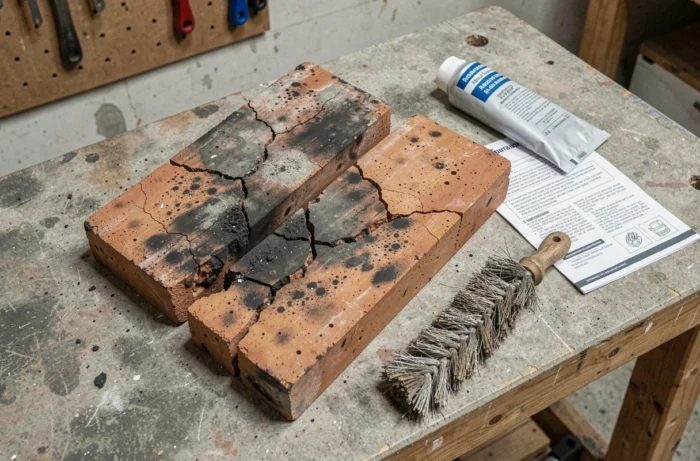
Refractory mortar or complete replacement: how to decide
Not all cracks are equal. A superficial micro-crack on a brick that remains in place does not compromise the stove’s operation. The refractory brick absorbs and radiates heat, and a fine crack does not change this capacity.
On the other hand, a brick that is fragmenting or moving when touched must be replaced. When a piece detaches, the firebox wall is no longer uniformly protected. The heat then reaches the stove’s metal structure, accelerating its aging.
When refractory mortar is sufficient
Chamotte mortar is suitable for filling stable cracks, meaning gaps that do not widen from one season to the next. Here are the conditions to meet:
- The brick remains attached to the wall, with no play or noticeable movement when you press on it.
- The crack is less than a few millimeters wide and does not go through the entire thickness of the brick.
- No chips have detached, and the surface remains generally flat.
In these cases, sealing with a high-temperature suitable mortar restores the thermal seal of the firebox.
When to replace the brick
If the brick is broken into two distinct pieces, if chips have fallen to the bottom of the firebox, or if you notice a gap that is widening between heating seasons, the repair will not hold. A replacement is necessary when the structure of the brick is compromised.
Repairing refractory bricks: materials and practical steps
Before buying anything, note the exact reference of your wood stove. Refractory bricks are not universal: their thickness, size, and composition vary by manufacturer and model. Check your device’s manual to verify the compatibility of the parts.
The right materials
- High-temperature refractory mortar: sold ready to use, it withstands the combustion temperatures of wood. Ensure that the product is indeed intended for direct contact with flames.
- A fine spatula or trowel to apply the mortar into the crack without overflowing.
- A damp cloth to clean ash and soot residues before application, as mortar does not adhere to a dirty surface.
- Replacement bricks compatible with your model, if the repair is insufficient.
Step-by-step application of the mortar
Wait until the firebox is completely cold. Remove the ashes and brush the surface around the crack. Slightly dampen the area with a cloth to promote the mortar’s adhesion.
Apply the refractory mortar into the crack by pushing the product towards the back with the spatula. Smooth the surface to avoid excess thickness. Allow to dry for the time indicated by the manufacturer before restarting the stove.
During the first use after repair, make a moderate fire. A gradual temperature increase allows the mortar to harden without experiencing thermal shock.
Wood stove maintenance: what really extends the lifespan of the firebox
Repairing a crack addresses the visible problem. But the longevity of refractory bricks mainly depends on what happens between repairs.
Chimney sweeping remains mandatory, even if combustion seems clean. The exact frequency depends on local regulations and the requirements applicable to your installation. A dirty flue alters the draft, disrupting combustion and overloading the firebox walls.
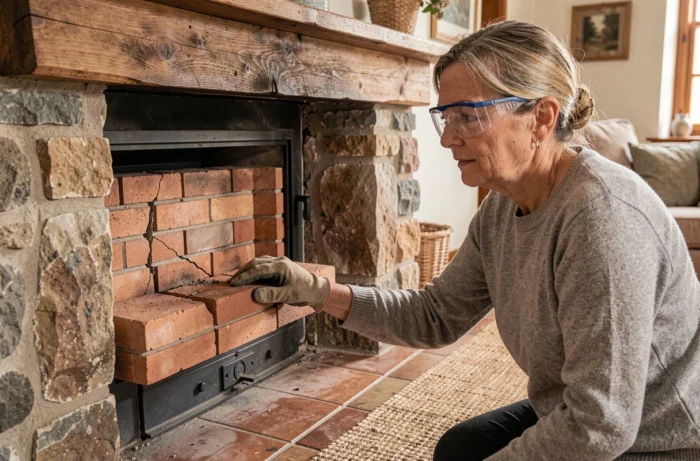
Check the condition of the bricks at the beginning of the heating season every year. Run your hand over the inner surfaces of the firebox to detect emerging cracks, chips, or areas that sound hollow.
A often overlooked point: vermiculite. Some stoves use vermiculite panels instead of chamotte bricks. This lighter material degrades differently. It crumbles rather than cracks. If your firebox has vermiculite plates, inspect their residual thickness, as a panel that is too thin no longer properly protects the structure.
When in doubt about the integrity of the firebox, especially if several bricks show deep cracks or if the metal structure shows signs of deformation, have the device evaluated by a professional. An early diagnosis prevents a complete stove replacement, which costs much more than a set of new bricks.