Every year, thousands of families hit the road with an infant without knowing that their car seat may be incompatible with the vehicle used, or that the way they dress their child reduces the effectiveness of the harness. A few technical checks before departure are enough to secure the journey with baby in the car.
Car seat and vehicle change: compatibility to check before each trip
This situation occurs more often than one might think. You rent a car for vacation, you get into a rideshare at the airport, or you borrow a relative’s vehicle. Your child’s car seat, perfectly fitted in your car, may turn out to be incompatible with the available vehicle.
A seat suitable for the child may be impossible to secure correctly depending on the anchoring system of the rental vehicle. In rideshare, the driver may even refuse the ride if no suitable restraint device is available. These cases are not marginal, especially during vacation departures where the stress of the journey adds to the logistics.
Before booking a rental vehicle or ordering a rideshare, check the Isofix or seatbelt compatibility of the seat you are transporting. On https://www.rouletitine.fr/, resources are available to identify equipment suitable for family trips. If you are traveling with an infant carrier, also bring the corresponding base, as without it, the seat may not secure at all.
i-Size standard and rear-facing: what regulations require since 2024
The regulations for car seats have evolved since September 2024. The i-Size standard now classifies seats according to the child’s height (and no longer just their weight), strengthens requirements during side impact tests, and mandates rear-facing until at least 15 months.
This last point changes the game for long trips. A 14-month-old child facing forward in an old seat compliant with the R44 standard no longer meets current recommendations. Switching to an i-Size seat may require reconfiguring the back seat, especially if another child is already using a booster seat.
Check compliance before a long car trip
The approval number is found on a label attached to the seat. A seat marked R44/04 remains legal, but an i-Size model (R129) offers superior side protection according to current testing criteria. For a purchase or replacement before vacation, choosing a seat classified by the child’s height simplifies future checks.
Harness and thick clothing: the invisible risk in winter
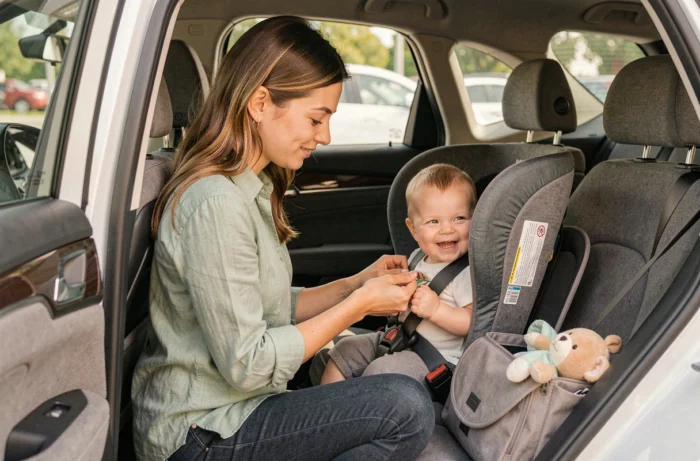
This is a trap that many parents overlook. A thick coat creates slack under the car seat harness and reduces its effectiveness in the event of sudden braking or a collision. The thickness of the fabric prevents the harness from fitting snugly against the child’s body.
The best practice is to secure the child without a coat, then cover them with a blanket or poncho. No additional accessories added to the seat (thick cover, extra cushion) should be used unless they are approved with the exact model of the seat.
- Remove the coat or puffer jacket before placing the child in the car seat, even if the cabin is still cold at startup.
- Adjust the harness until only one finger can slip between the strap and the child’s collarbone.
- Cover the harness with a lightweight blanket or travel poncho, never under the straps.

Road breaks with baby: why not wait for the cries
There is a strong temptation to leave a sleeping baby in their seat for as long as possible, especially when the journey is going well. Field reports vary on this point, but the recommendation remains clear: breaks are necessary even when baby is sleeping.
Taking the child out of the seat allows for a change of position, relieves pressure on their back, and checks their comfort (temperature, diaper, blood circulation). Waiting for cries or waking up as a signal for a break is not a reliable strategy, as an infant can remain silent while still being uncomfortable.
Situations that justify medical advice before departure
Medical advice should be individualized in certain specific cases. A baby born prematurely, a child with a respiratory issue, or a trip to a remote destination (far from care facilities) justify prior consultation with a doctor or midwife. Applying general travel advice without considering these particularities can expose the child to an avoidable risk.
- Prematurity: the prolonged semi-reclined position in an infant carrier can hinder breathing in some infants born preterm.
- Gastroesophageal reflux: the angle of the seat may worsen symptoms on a journey lasting several hours.
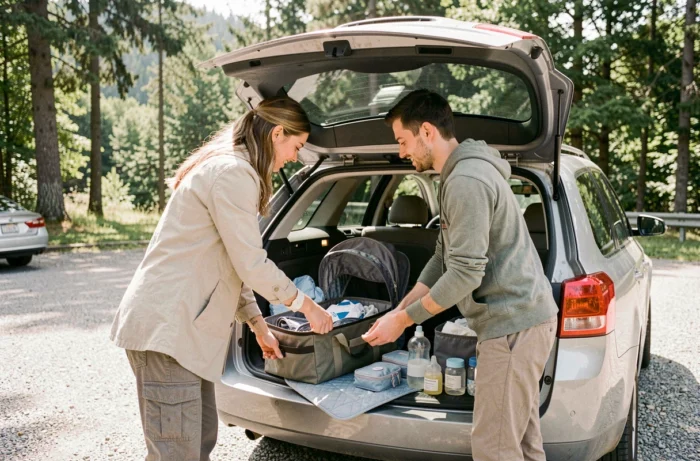
- Remote destination: prepare a suitable first aid kit and know the location of the nearest medical center along the route.
Traveling by car with a baby does not require excessive preparation, but a few technical checks make the difference between a controlled journey and a blind departure. Checking the compatibility of the seat with the vehicle, ensuring compliance with current standards, adjusting the harness without thick clothing, and planning regular breaks cover the essentials of what matters for the infant’s safety on the road.