The size indicated on a cap’s label guarantees nothing. Between the manufacturing discrepancies from one brand to another, the sweatbands whose compliance varies depending on the material, and the actual ranges covered by adjustable systems, the choice of size is more about morphological diagnosis than a simple reading of a size chart.
Pressure points and compression lines: signals that the size is wrong
A cap may display the correct head circumference in centimeters but still cause issues when worn. Comfort is not limited to circumference: it depends on the distribution of pressure on the skull.
We regularly observe localized compression lines on the forehead and temples, even when the measured head circumference corresponds to the indicated size. These marks reveal an inner band that is too narrow or an insufficient cap volume for the shape of the skull.
The reference test in the fitting room remains simple: slide a finger between the band and the forehead. The finger should pass through without forcing, but the cap should neither rotate nor rise. If it rotates, the interior volume is too large. If the finger does not pass, the frontal pressure will become uncomfortable after an hour of wear.
Beyond the forehead, check the temporal area. A model with a rigid structure (reinforced front panel, thick side stitching) pressing on the temples causes a gradual discomfort that head circumference alone cannot anticipate.

To delve deeper into the measurement method and the correspondences between sizing systems, the cap size guide on Le Comptoir de Violette details each step precisely.
Adjustable cap and one size: a range narrower than advertised
The mention “one size” or “adjustable” is misleadingly reassuring. Most adjustable caps cover a rather limited head circumference range, often presented simplistically on the label. Relying solely on this indication leads to marks on the forehead or a cap that flies off at the first gust of wind.
Several factors explain this discrepancy between the advertised range and the actual range:
- The adjustment mechanism (snapback, strapback, metal buckle) only compensates for a few centimeters. Beyond its mechanical range, it distorts the curvature of the back panel and alters the fit.
- The inner band, often made of cotton or thermally bonded synthetic material, has limited elasticity. After a few months of use, it stretches without regaining its original tension, which shifts the comfort range downward.
- The depth of the cap is never mentioned on the label. A high skull in a low cap creates a top compression effect that the rear adjustment does not resolve.
We recommend always measuring the actual head circumference before purchasing an adjustable cap, rather than relying on the “one size” label.
Measuring head circumference: positioning the tape and reference errors
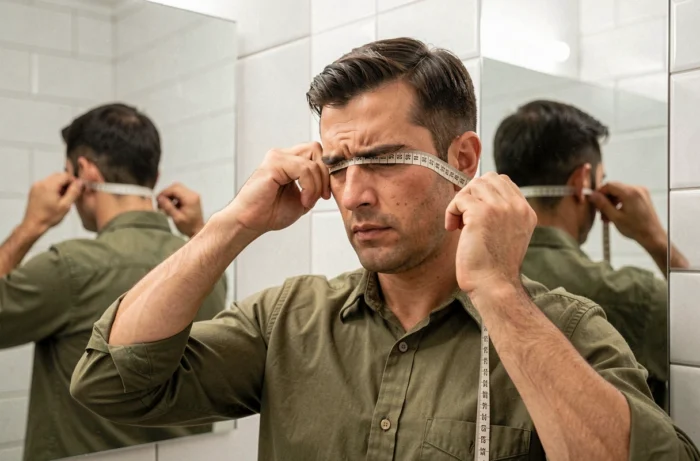
The gesture seems elementary, but most sizing errors come from improper placement of the measuring tape. The correct reference passes above the ears and just above the eyebrows, where the cap’s band will actually rest.
Measuring too high (in the middle of the forehead) gives a value that is one to two centimeters lower, enough to end up between two sizes and choose the wrong one. Measuring too low (on the eyebrows themselves) overestimates the circumference and leads to a floating model.
Skull morphology and depth choice
Head circumference alone is not enough to characterize skull shape. Two people with the same perimeter can have very different skull depths (round skull, elongated oval skull). Caps with structured crowns (like six-panel baseball caps) are better suited for round skulls, while soft crown models (five-panel, camper caps) conform more to oval shapes.
This distinction does not appear in any standard size chart. Yet it is the factor that explains why a model “in the right size” seems poorly fitted on certain heads.

Cap size according to model type: baseball, flat, trucker
Each cap construction involves a different relationship between head circumference and perceived comfort. General guides apply a single size chart to all styles, which generates systematic errors.
A flat cap (like a newsboy or Irish cap) covers more of the skull and distributes pressure over a wider surface. The band plays a secondary role. In contrast, the choice of size depends mainly on the depth of the cap and the desired lateral drop.
On a structured baseball cap, the rigid front panel imposes its shape on the forehead. If the size is correct, the visor remains horizontal. If it is too large, the visor slightly rises on the sides. The position of the visor is a reliable indicator of poor fit, more telling than the sensation of tightness.
Trucker models, with their mesh back and snapback, offer the widest adjustment range, but their high and rigid crown does not suit flat skulls. The unfilled volume at the top creates a “mushroom” effect that the rear adjustment does not correct.
When size changes: wear of the band and wearing conditions
A new cap does not fit the same after several weeks of wear. The inner band, especially if made of cotton, gradually stretches and loses support. We recommend choosing a model that fits very slightly at purchase rather than one that is immediately comfortable, as it will stretch.
Heat and humidity also alter the behavior of the band. A wool or synthetic blend model maintains its shape better in hot weather than pure cotton, which absorbs sweat and softens.
Lastly, a point often overlooked: washing. A machine wash, even at low temperature, can shrink the crown or distort the visor. Prioritizing hand washing preserves the original size and avoids distorting the fit achieved over time.