
The French DIY market is going through a stabilization phase after several years of decline. Physical stores are losing ground, the share of online sales is increasing, and amateur DIYers are faced with an overwhelming array of options. In this context, knowing what to prioritize when buying tools for home improvement without accumulating unnecessary equipment deserves more careful consideration than the usual generic lists.
Battery compatibility: the criterion that tool lists overlook
Most buying guides recommend a drill-driver, a jigsaw, and a sander. They overlook a technical point that weighs heavily on the budget in the medium term: battery compatibility between tools of the same brand.
Read also : Simple tips for easily recording a video from the Internet in 2024
Manufacturers offer ranges where a single battery format powers multiple devices. Choosing a coherent ecosystem from the start (same voltage, same connection) avoids having to buy an additional battery for each new tool. Field feedback varies on this point depending on the brands, but the principle remains the same: a shared battery-charger pack significantly reduces the overall cost.
Before buying the first power tool, the question to ask is not “which drill?” but “which battery platform do I choose for the next five years?”. Those who wish to delve deeper into the subject will find detailed comparisons on equipment on Ben Le Bricoleur, with concrete feedback by range.
You may also like : How to email a CAF expert for quick answers
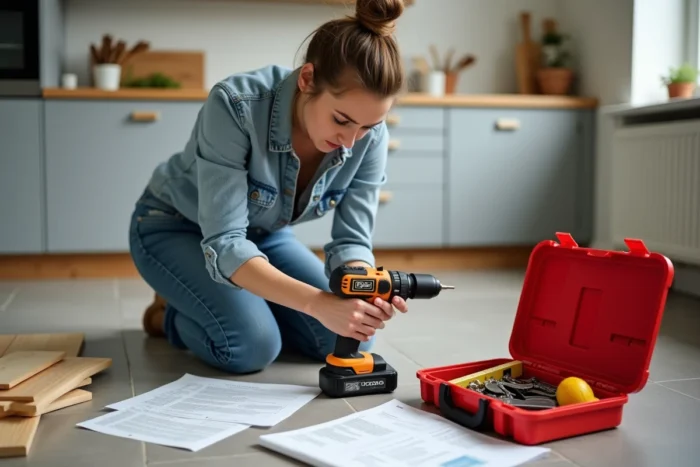
Hand tools for DIYers: what is truly useful every day
A Phillips screwdriver and a flat screwdriver are not enough. The screws used in contemporary furniture, common hardware, and electrical equipment use Torx, Pozidriv, or hexagonal heads. A set of multi-bit screwdrivers covers the majority of situations without multiplying purchases.
The hammer remains a basic tool, but its weight affects its use. A hammer that is too heavy tires the wrist during repetitive tasks. An intermediate weight model, with a fiberglass handle rather than wood, absorbs vibrations better.
Pliers and wrenches: two versatile tools
A quality adjustable pliers replaces several specialized tools for tightening, holding, or turning fittings. An adjustable wrench completes the duo for standard nuts. These two tools cover most light domestic plumbing interventions (faucets, visible fittings).
- Adjustable pliers with ratchet: prefer a model with treated jaws that do not slip on chrome surfaces
- Medium-sized adjustable wrench: compact enough to work under a sink, wide enough for common nuts
- Set of Allen keys (hex keys): often forgotten, they are essential for almost all flat-pack furniture and some heating equipment
Measuring and marking: precision before power
A five-meter tape measure and a spirit level are the bare minimum. The majority of DIY errors come from approximate measurements, not from an unsuitable cutting tool.
The laser level has significantly decreased in price in recent years. For installing shelves, aligning frames, or marking a tiling line, it saves considerable time compared to a traditional spirit level. Available data does not allow for concluding that an entry-level model is reliable in the long term, but for occasional home use, the precision gaps remain acceptable.
The square: underestimated yet decisive
Marking a right angle on a board before cutting it seems trivial. Without a square, the line deviates by a few millimeters, the cut goes awry, and the assembly does not hold. A stainless steel carpenter’s square is inexpensive and lasts for decades.
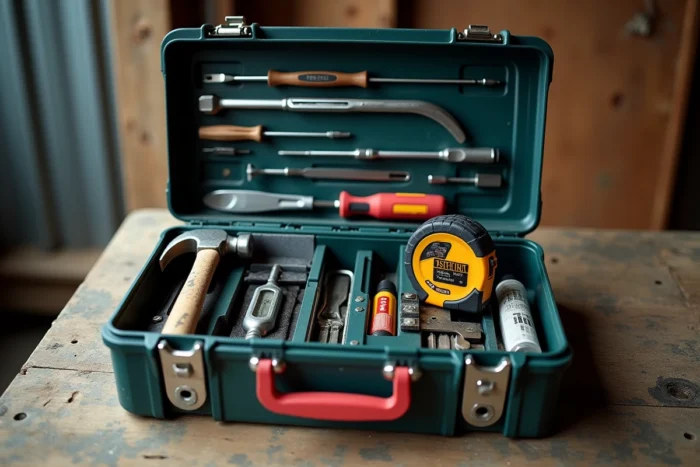
DIY safety: the protections that no one buys first
Safety glasses, gloves, and earplugs usually come last in the shopping cart. They should be at the top of the list.
A metal or wood splinter in the eye ends a DIY session permanently. Wraparound safety glasses with anti-fog treatment cost just a few euros. Reinforced work gloves protect against cuts when handling sheet metal, glass, or raw wood.
- Wraparound safety glasses: to be worn systematically during drilling, sanding, or cutting
- Cut-resistant gloves: useful for handling sharp materials, but should be removed for precision work
- Hearing protection (molded plugs or headphones): the jigsaw and grinder exceed the comfort threshold, even for short sessions
- FFP2 dust mask: sanding old paint or treated wood releases fine particles that are not visible
Buying tools online or in-store: what the DIY market reveals
The share of online DIY sales is projected to be 19% by 2026 according to a market study published by Accio. This growth is changing shopping habits: comparison sites, bundled tool packs, promotions on specialized platforms.
On the other hand, in-store purchases retain a difficult-to-replicate advantage online: the hands-on experience. The weight of a drill, the ergonomics of a saw handle, the flexibility of a tape measure are better judged in-store than on a product sheet. For hand tools, testing before buying remains relevant. For consumables (blades, bits, abrasives), online shopping often allows access to more economical packs.
Home DIY does not require a complete workshop from day one. A coherent battery platform, a set of hand tools covering common bits, reliable measuring instruments, and personal protective equipment provide a sufficient foundation for handling the vast majority of common tasks. The rest can be acquired over time as needs become clearer.