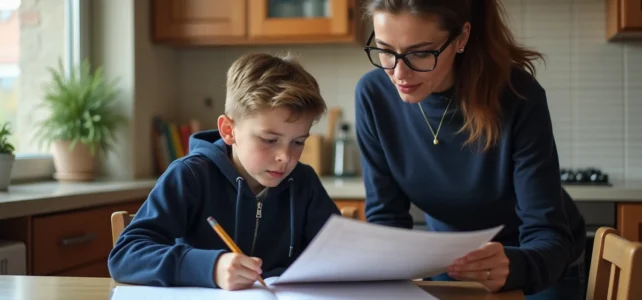
The class record at middle school refers to the administrative document that summarizes, for each student, the assigned class, the chosen options, and the information provided to the institution in preparation for the following school year. For the 2026-2027 school year, several changes directly affect this document and its context: new cycle 4 programs, flexibility in need groups, and changes to the diploma. Understanding these changes allows parents to fill out the class record with the correct references.
New cycle 4 programs: what the class record must reflect
The cycle 4 programs (7th, 8th, 9th grades) applicable for the 2026-2027 school year modify the content taught in French, mathematics, and several other subjects. The class record incorporates these developments because it serves as a support for the choices of options and complementary teachings offered by each institution.
Further reading : The Latest Trends and Tips for Success in the B2B Sector in 2024
The back-to-school circular for 2026 emphasizes a pedagogical refocusing: prioritizing the quality of learning over its quantity. For families, this translates into sometimes reformulated teaching titles on the class record, and the disappearance or grouping of certain options that existed in previous years.
Before validating the record, it is useful to compare the proposed teachings with those of the current year. If a title has changed or if an option no longer appears, the school’s administration can explain what reorganization this corresponds to. Parents who want to know everything about the 2026 class record should consult the official bulletin from July 2026, which details the programs in effect.
Need groups in French and mathematics: a framework that has become optional
Since a decree published in March 2026, need groups in French and mathematics are no longer mandatory in middle school. Established at the start of the 2024 school year for 6th and 7th grades, these groups differentiated students according to their level in these two subjects. Their now optional nature changes the game for the 2026 class record.
In practice, each middle school decides independently whether or not to maintain these groups. The class record may therefore mention a need group in one institution and not in another, even within the same city. For parents, careful reading of this point on the document prevents misunderstandings at the start of the school year.
Consequences for course organization
A middle school that eliminates need groups returns to full classes in French and mathematics. The teacher then adapts their pedagogy within a heterogeneous group. A middle school that maintains them continues to distribute students according to their achievements, with possible adjustments during the year.
The class record does not always explicitly mention the maintenance or abandonment of groups. If this information is not included, a direct question to the main teacher or the head of the institution during the third-term class council can clarify any ambiguity.
2026 diploma: the increased weight of final exams and its link with the 9th-grade record
For 9th-grade students, the class record is set in a particular context: the new 2026 diploma increases the weight of final exams compared to continuous assessment. The grades obtained in class still count, but the share of final exams is increasing.
This rebalancing impacts how families approach the 9th-grade class record. The chosen options (foreign languages, artistic teachings, Latin or Greek) do not all weigh the same in the final diploma calculation. Checking the coherence between the options checked on the record and the student’s strategy for the diploma deserves special attention.
- The written exams in French, mathematics, history-geography, and sciences weigh more than before in the overall diploma score.
- Continuous assessment is still taken into account, but with actual grades (and no longer just competency-based assessments in some cases).
- Optional options can provide bonus points, provided they were declared on the class record before the deadline set by the institution.
Deadline and common mistakes
The 9th-grade class record generally needs to be returned before the end of the second term. A common mistake is forgetting to check an optional subject that the student has been following since 7th grade. Without this mention, the bonus points related to the option are not counted towards the diploma.

Self-regulation systems for students with neurodevelopmental disorders: a new feature to note on the record
A call for applications launched for the 2026-2027 school year plans to create new self-regulation systems in volunteer middle schools, aimed at students with neurodevelopmental disorders (NDD). Each system pairs a teacher with several medical-social professionals, with a dedicated room in the institution and effective support starting on the first day of school.
For the families concerned, this information directly modifies the content of the class record. If the student benefits from a personalized schooling project (PSP) or a personalized support plan (PAP), these systems must be mentioned. The host middle school must also be clearly indicated if the child is assigned to an institution with such a system.
Each system must support at least ten students. Parents whose child has an NDD should reach out to the MDPH and the middle school as early as spring to check eligibility and registration procedures.
Demographic decline in middle school: an indirect parameter on class records
The secondary education sector loses between 30,000 and 40,000 students per year according to data discussed in the National Assembly. Over ten years, the projection reaches a decrease of 745,000 students. This demographic decline affects the school map and, by extension, the class records.
Classes may merge, options may disappear due to insufficient numbers, or institutions may modify their training offerings. The class record reflects the actual offerings of the middle school, which directly depend on its projected enrollment. A rural middle school that loses a 7th-grade class may eliminate a second foreign language option or a complementary teaching.
- Check that the desired options are still offered for the following school year, especially in low-enrollment institutions.
- Anticipate a possible change of school if a rare option (European section, bilingual class) is no longer maintained.
- Consult the department’s training map, updated each year by the rectorate.
The 2026 class record is not a simple administrative form to fill out in five minutes. Between the revised programs, the revamped diploma, and the now optional need groups, each checked box commits the student’s school year. Rereading the document with the official back-to-school bulletin in hand remains the most reliable reflex.