Summer 2026 in Brussels combines repeated heatwaves and pressure on the water network. When hot water disappears from the tap, the cause is not always where one might think. Boiler breakdown, scheduled network cut by VIVAQUA, overconsumption related to the heatwave: each scenario calls for a different reaction. Here’s how to identify the source of the problem and respond appropriately.
Network cut or internal failure: distinguishing the source of the problem
The first reflex when hot water stops flowing is to check if cold water is arriving normally. If even cold water is absent or if the flow is abnormally low, the problem is likely upstream of your installation.
VIVAQUA schedules temporary water cuts on certain distribution sites, with a 72-hour notice communicated to residents. This is the case, for example, for the Médori/Robiniers/Prince Charles site, documented in August 2026. A VIVAQUA technical emergency number is available at all times to report an abnormal situation.
If cold water flows normally but hot water remains lukewarm or cold, the issue lies within your internal installation. Before contacting a heating technician, it’s worth conducting a few checks yourself when encountering a hot water problem in Brussels, particularly regarding the boiler pressure and gas supply.
Boiler breakdown in summer in Brussels: common causes

A boiler that runs all winter can break down precisely in summer. With central heating turned off, the boiler only operates in sanitary mode. This intermittent operation reveals weaknesses that continuous winter use had masked.
The limescale-clogged heat exchanger
Limescale is a recurring problem in Brussels installations. The plate exchanger, which transfers heat from the heating circuit to the sanitary water, gradually becomes clogged with limescale. When deposits reach a certain threshold, the hot water flow drops without the boiler displaying any error. Descaling the exchanger usually restores normal operation.
The circulation pump malfunctioning
After several months without use of the heating circuit, the circulation pump can become stuck. Some models remain jammed upon summer restart in sanitary mode. A technician can usually manually unstick the shaft, but replacement is necessary if the motor is damaged.
Pressure in the circuit too low
Check the pressure gauge on your boiler. A pressure below the minimum threshold prevents hot water production on many models. Adding water to the circuit via the filling tap sometimes resolves the issue, provided there are no leaks in the circuit.
Gas cut and hot water: an underestimated chain reaction
Sanitary hot water directly depends on the gas supply in the majority of Brussels homes. A gas cut, even localized and temporary, interrupts hot water production.
In August 2026, the municipality of Woluwe-Saint-Lambert reported a gas cut in the Val des Épinettes neighborhood and on Avenue Prince Baudouin. Affected residents lost their hot sanitary water. The municipality directed residents towards neighborhood solidarity as a first response, then to a municipal contact for prolonged situations.
This type of incident illustrates a point that households often overlook: the hot water failure does not always have an internal technical origin. Before calling a heating technician, it’s useful to check with your neighbors if they are also affected, and then consult announcements from your municipality or the network operator.
Pressure on the drinking water network in Brussels in summer 2026
The heatwaves of summer 2026 created a particular situation. VIVAQUA asked Brussels residents to reduce their water consumption, indicating that water distribution was under pressure during heat peaks. Brussels Environment also maintained a yellow drought alert level activated at the end of August 2026.
This pressure on the network can result in localized flow reductions, especially during peak hours. When the cold water flow decreases, the hot water flow mechanically follows since the boiler receives less water to heat. Some boilers even go into safety mode if the incoming flow drops below a minimum threshold.
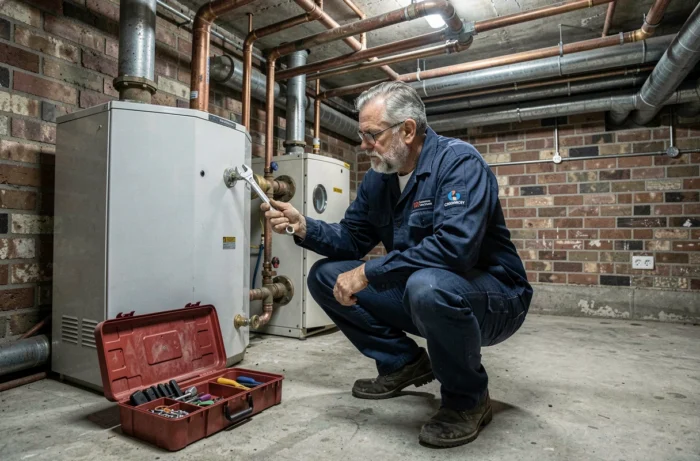
In practical terms, a temporary drop in pressure related to the network does not require technical intervention. However, if the problem persists after returning to normal flow, the installation deserves inspection.
Checklist before calling a professional
Before making an appointment with a heating technician (whose response times lengthen during periods of high summer demand), a few checks can eliminate simple causes:
- Open a cold water tap to check that the flow and pressure are normal. If cold water does not flow or flows very weakly, the problem is related to the network and not your boiler.
- Check the boiler pressure gauge: the circuit pressure should be within the range indicated by the manufacturer. If it is too low, refill the circuit via the designated tap.
- Ensure that the boiler thermostat is set to hot water production mode and that the set temperature has not been accidentally changed.
- Make sure the gas supply is functioning by testing another gas appliance (such as a stove). If no appliance works, contact the network operator.
- Consult the VIVAQUA website and municipal announcements to check that no water or gas cuts are ongoing in your neighborhood.
If all these checks are negative and the problem persists, the intervention of a certified professional becomes necessary. Remember to note the error code displayed by the boiler before calling, as this information speeds up remote diagnosis.
Summer in Brussels tests sanitary installations in a way different from winter. A boiler breakdown in summer often reveals insufficient maintenance rather than a sudden failure. Regular descaling of the exchanger and annual pressure checks remain the two most effective preventive actions to avoid being left without hot water when the heat makes a cold shower less bearable.