What criteria allow us to distinguish a truly structural fashion trend from a mere seasonal effect? The answer is no longer found solely on the runways: it is now read in regulatory texts, in brand communication strategies, and in the way the sector’s vocabulary transforms under legal pressure. Autumn 2026 marks a measurable turning point for anyone following fashion trends and their inspirations.
Anti-greenwashing directive and fashion: what the regulation concretely changes
The European directive (EU) 2024/825, applicable from September 27, 2026, redefines the rules of the game for the entire textile sector. Its impact goes beyond mere legal compliance: it changes how brands build their image and communicate about their collections.
Several common terms in fashion marketing become unusable without certified proof. The words “eco-friendly,” “green,” and “sustainable” are prohibited without third-party certification compliant with the EN ISO 14024 standard. Sustainability logos created internally by brands, without independent validation, are now considered unfair commercial practices.
Claims such as “carbon neutral” or “zero emissions” based solely on carbon offsetting are no longer acceptable either. They must be based on a direct and verifiable reduction of emissions.
| Marketing Practice | Before September 27, 2026 | After September 27, 2026 |
|---|---|---|
| “Sustainable collection” mention | Allowed without specific justification | Prohibited without certified European eco-label |
| Internal “eco-friendly” logo | Free to use | Prohibited without independent third-party certification |
| “Carbon neutral” claim | Possible via offsetting alone | Requires proven direct reduction of emissions |
| “Environmentally friendly” term | Commonly used in campaigns | Requires documented “excellent” environmental performance |
This framework forces creative directors to rethink their storytelling. A brand that built its visual identity around “green” codes (nature tones, kraft packaging, bucolic vocabulary) must find another aesthetic register or invest in real certification. To explore fashion on Bohème Magazine, this regulatory shift serves as a relevant filter to assess the credibility of new collections.

Autumn 2026 fashion trends: aesthetic codes that withstand analysis
When the marketing gloss is removed, three stylistic axes stand out for their persistence over several seasons and their grounding in real changes in the wardrobe.
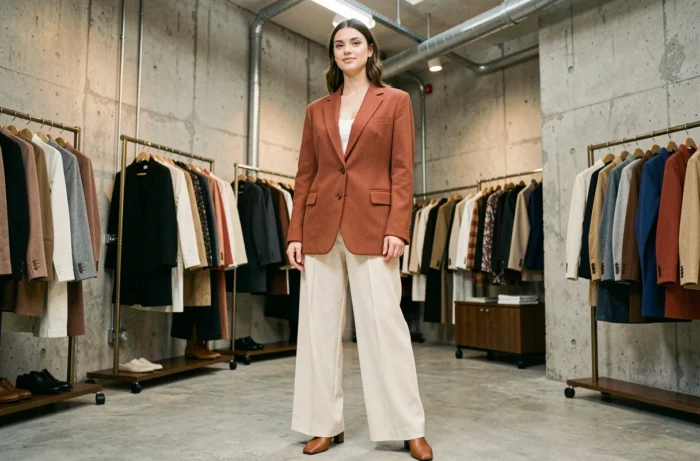
Structured silhouettes and architectural volumes
Recent shows in Paris and London confirm a return to constructed pieces. Defined shoulders, geometric cuts, and controlled layering are gradually replacing the relaxed sportswear that has dominated for several years.
The structured silhouette reflects a renewed need for formality, visible in both ready-to-wear and designer collections. This is not just a simple cycle: the trend is supported by a return to the office post-remote work and a measurable fatigue with all-casual.
Colors and materials: the return of refined monochrome
Seasonal palettes are leaning towards muted tones and tonal variations rather than the saturated colors that characterized previous collections. Head-to-toe monochrome is becoming a dominant style code again, but with a richer textural treatment (mixes of knits, layering of matte and shiny textures in the same shade).
On the other hand, maximalist prints are not disappearing. They focus on isolated pieces (a jacket, an accessory) rather than complete looks, marking a clear departure from the 2024-2025 trends.
Fashion inspirations and art: a crossover that changes the reading of collections
The influence of visual arts on fashion is not new, but it is taking a more documented form. Several houses are now integrating explicit artistic references in their lookbooks, with credits and context, rather than simply “drawing inspiration” from a movement without naming it.
- Collaborations between fashion brands and cultural institutions (museums, galleries, foundations) are multiplying and structuring the collection calendar beyond traditional fashion weeks.
- Street style photographed in Paris and London shows a growing adoption of artistically dimensioned pieces (screen prints, narrative embroidery, patterns from specific works) as markers of a claimed personal style.
- Social media amplifies this crossover: the fashion content that performs best associates a look with a cultural context (exhibition, book, film) rather than just a product reference.
Art becomes a measurable criterion of stylistic differentiation, not just a vague inspiration. Brands that document their sources gain credibility with an audience increasingly attentive to the authenticity of creative approaches.
Fashion vocabulary and credibility: the regulatory filter as a reading grid
The directive (EU) 2024/825 is not only about environmental claims. It establishes a verification reflex that is beginning to permeate how consumers evaluate the entire discourse of brands.
A look presented as “sustainable trend” without tangible proof loses its perceived value. Fashion vocabulary is being restructured around traceability and proof, not just aesthetics. Brands that anticipate this movement are reformulating their product sheets, their campaigns, and even the wording of their labels.
This phenomenon also changes purchasing criteria. The question “is it beautiful?” is now accompanied by “is it verifiable?”, which redistributes the cards between established brands with certification means and smaller players who will need to find other proofs of legitimacy.
Fashion trends for the upcoming seasons will be read as much in the collections as in the legal mentions that accompany them. European regulation transforms greenwashing into a real legal risk, and this constraint redraws the contours of what “exploring fashion from a new angle” concretely means. Brands, media, and consumers now share the same imperative: verify before asserting.