
Kafkaesque literature is not reduced to a worn-out adjective. It constitutes a narrative apparatus whose formal mechanisms continue to structure contemporary fiction, from Japanese novels to European theater, including legal doctrine. Understanding this influence requires going beyond thematic reading (the absurd, bureaucracy) to enter the technical device that Kafka developed between 1912 and 1924.
Kafkaesque Narrative Device: Internal Focus and the Logic of Impasse
Kafka’s technical signature relies on a locked internal focus on a protagonist who does not understand the system. The reader never has an overarching view. In The Trial as in The Castle, information arrives filtered, contradictory, incomplete. This is not a thematic choice; it is a construction process.
This mechanism produces a precise effect: the narrative progresses without advancing. Each chapter adds elements that resolve nothing, sometimes negating what came before. Kafka worked without a detailed plan, allowing the text to develop through the accumulation of autonomous scenes.
This device has spawned a considerable formal lineage. Novelists like Haruki Murakami adopt this structure where the character seeks without finding, traversing spaces that elude them. In Kafka on the Shore, Murakami borrows the very name of the Prague author and constructs a narrative with a dual storyline where causal logic gradually dissolves.
The resources gathered by kafkaiens.org allow for mapping these literary filiations and the critical extensions of the work in several languages.
Kafka and Japanese Literature: Murakami, Tokyo, and the Prose of Uncertainty

The link between Kafka and Japan is not limited to a novel title. Haruki Murakami has built a significant part of his work on processes directly derived from Kafkaesque narratology. In The Murder of the Commander, the disappearance of a character in an underground space revisits the motif of passage to a realm governed by incomprehensible rules, a central motif in The Burrow and In the Penal Colony.
Murakami transposes the Kafkaesque into contemporary Japanese daily life. The protagonist lives in Tokyo or an ordinary suburb, has a mundane job, and then slips into a zone where reference points collapse. The characters’ movement from one place to another, the walls that separate parallel worlds, the books that contain embedded narratives: all of this constitutes a technical heritage, not a mere reference.
This cultural transfer between Prague and Japan illustrates a point that generalist criticism underestimates: the Kafkaesque functions as an exportable narrative grammar, independent of its historical context of origin. Contemporary Japanese literature has absorbed it without needing to share the experience of Mitteleuropa.
Kafka in Law and Theater: Non-Literary Uses of the Work
The Kafkaesque influence far exceeds the realm of fiction. In October 2024, the legal publishing house Dalloz published La justice selon Kafka, a volume edited by Nathalie Wolff and Laura El Makki in the “Connaissance du droit” collection. The book brings together academics, magistrates, and translators to analyze what The Trial contributes to the reflection on the functioning of justice and its shortcomings.
Kafka is now mobilized as a critical tool in legal doctrine, beyond the simple metaphor of the “Kafkaesque trial” that the media use imprecisely. The Dalloz volume addresses concrete issues: access to the file, the opacity of administrative procedures, the relationship between the norm and its application.
On European stages, adaptations are multiplying. Clément Poirée staged Josef K. at the Théâtre de la Tempête, a performance that does not seek to illustrate the novel but to extract a scenic mechanism from it.
- Legal doctrine uses Kafka to question the opacity of procedures and the relationship of the litigant to the institution.
- Contemporary theater extracts from the Kafkaesque text scenic devices (spatial confinement, repetition of sequences) rather than faithful adaptations.
- In Ireland, the Dublin Fringe 2026 has programmed Kafka’s Doll, a performance that starts from a biographical anecdote to construct a piece independent of the novel corpus.
Critical Editions and Re-reading by Walter Benjamin: The Philological Renewal
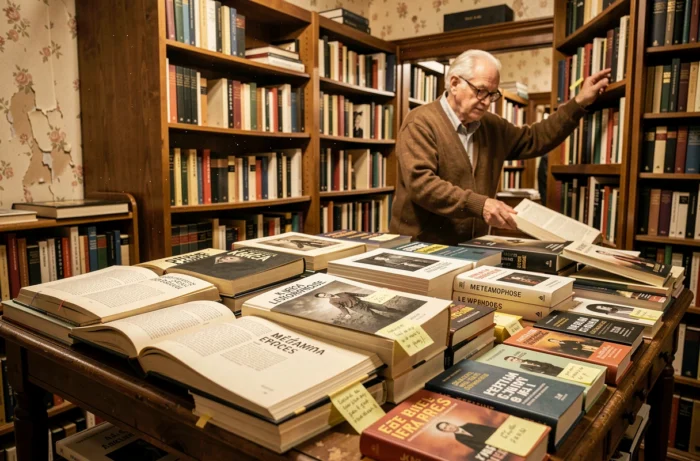
The centenary of Kafka’s death in 2024 has triggered an editorial wave that goes beyond commemoration. In Italy, the publisher Castelvecchi published Il mio Kafka in January 2024, gathering for the first time in a single volume all of Walter Benjamin’s writings on Kafka, including the major 1934 essay, letters, and previously scattered fragments.
This type of publication alters the reception of the work. Benjamin read Kafka not as an author of the absurd but as a narrator of the interrupted gesture, of action that does not come to fruition. This reading aligns with the formal question posed earlier: Kafka’s prose progresses without resolution.
These publications recontextualize Kafka outside the cliché of the tortured writer to place him within a history of literary forms.
The philological renewal surrounding Kafka confirms that his work remains an active field of investigation. The novels, unfinished stories, and correspondence continue to produce fresh readings because the textual device resists any definitive interpretation. It is this resistance that makes Kafkaesque literature a living object, not a fixed monument.