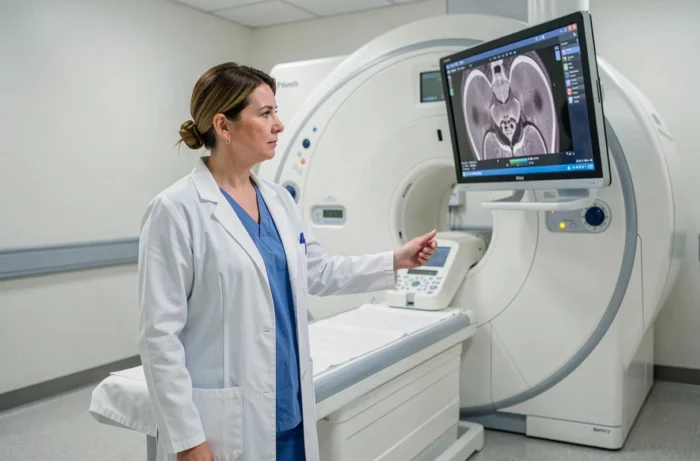
A pelvic MRI performed at a public hospital is based on a base rate set by Health Insurance, but the actual amount billed to the patient varies depending on the radiologist’s agreement, the type of facility, and the supplementary health insurance subscribed. Understanding these mechanisms avoids unpleasant surprises at the time of payment.
Technical fee and medical fees: the two billing lines of a pelvic MRI
The cost of an MRI is divided into two distinct items that many patients discover on their bill without having anticipated them. The first is the technical fee, paid to the facility that operates the machine. It covers the depreciation of the machine, maintenance, and the operation of the technical platform.
The second item corresponds to the radiologist’s fees who interprets the images. This amount depends on the practitioner’s agreement sector. In sector 1, the radiologist applies the base rate of Health Insurance without exceeding it. In sector 2, additional fees are possible, even in a public hospital that hosts private practitioners.
In the hospital, the technical fee is generally regulated, but some additional charges may remain depending on the patient’s status and the billing conditions of the facility. To consult a detailed comparison of the price of an MRI at the hospital, several resources allow you to locate the actual range according to the region and type of structure.
A point often overlooked: the injection of contrast agent (gadolinium), sometimes necessary for pelvic imaging, generates an additional charge. This extra cost appears on a separate line and is partially reimbursed by Social Security.

Social Security reimbursement and actual out-of-pocket costs for the patient
Health Insurance covers the pelvic MRI up to 70% of the base rate, provided that the coordinated care pathway is respected. The patient must have a prescription from their primary care physician or a referring specialist. Without this prescription, the coverage drops significantly.
The out-of-pocket costs include the co-payment, any additional fees, and the flat-rate participation. In 2026, the doubling of medical deductibles changes the calculation for patients who accumulate multiple procedures throughout the year. The annual cap on these deductibles has been raised, meaning that the accumulation of consultations, radiological exams, and partially reimbursed care can increase out-of-pocket costs faster than before.
For patients with ALD (long-term illness), the pelvic MRI prescribed as part of the care protocol is reimbursed at 100% of the base rate. However, additional fees remain the responsibility of the patient or their mutual insurance.
What a supplementary health insurance actually covers
The mutual insurance intervenes at three levels depending on the contract subscribed:
- The co-payment (the remaining 30% of the base rate), covered by almost all responsible contracts
- The additional fees, partially or fully covered depending on the level of guarantee (high-end contracts reimburse more, especially in the case of the radiologist’s OPTAM membership)
- Additional costs such as the injection of contrast agent, whose complementary reimbursement depends on the “medical acts” section of the contract
A basic contract rarely reimburses additional fees beyond 100% of the conventional rate. For a pelvic MRI performed by a radiologist in sector 2 without OPTAM, the difference can represent several dozen euros.
Reducing the bill: agreement sector and choice of facility
The main lever to limit the cost of a pelvic MRI remains the choice of the radiologist and the facility. An examination performed in a public hospital with a salaried practitioner (and not private) eliminates the risk of additional fees on the interpretation part.
Imaging centers contracted in sector 1 with OPTAM offer an interesting compromise: the private practitioner commits to limiting their additional fees, and the mutual insurance reimburses better for acts performed under this system. Before making an appointment, checking the radiologist’s agreement status on the Ameli directory or directly with the imaging center allows you to anticipate the out-of-pocket costs.
Waiting times and impact on the care pathway
Access times for a pelvic MRI vary greatly depending on the regions. In some under-equipped areas, the wait can reach several weeks. This parameter sometimes pushes patients towards private centers that charge higher additional fees, either out of urgency or due to lack of nearby alternatives.
Asking the prescribing doctor if they have a priority slot at a hospital technical platform, or contacting the hospital’s radiology department directly, can shorten this wait without extra cost.

Pelvic MRI at the hospital: points to check before the exam
Some checks in advance avoid unexpected costs or incomplete reimbursement:
- The prescription must mention the anatomical area (pelvis) and the medical reason, otherwise the Health Insurance may refuse coverage
- The primary care physician must be registered with Social Security for the 70% reimbursement rate to apply
- In case of gadolinium injection, check with the center if a recent renal assessment is required (creatinine level), as the absence of this assessment may delay the exam
- Request a written estimate from the imaging center if the radiologist practices in sector 2, to know the exact amount of the additional fee before the exam
A prior estimate is not mandatory for an MRI, but any serious center provides it upon request. This document also allows you to seek prior agreement from the mutual insurance for significant additional fees.
The overall cost of a pelvic MRI at the hospital therefore depends less on the price of the procedure itself than on the practitioner’s agreement status and the level of supplementary coverage. Checking these two parameters before making an appointment remains the most reliable way to control the expense.