In geriatric consultation or home visits, one often finds themselves searching for the right version of the Tinetti test on their phone, between two patients. The form we printed last week has disappeared into a folder, and the one found online doesn’t quite match the items we usually use. This confusion is not anecdotal: it reflects a documented problem in the literature.
Several versions of the Tinetti are circulating, and none are validated in French
The Tinetti test, also known as POMA (Performance-Oriented Mobility Assessment), assesses the mobility of the elderly subject on two sub-scales: balance (scored out of 16 points) and gait (scored out of 12 points), for a total score out of 28. The patient is observed during position changes and daily walking maneuvers, without specific equipment.
The problem is that there is not just one Tinetti test. An analysis of 37 publications showed that the name, items, scoring, and thresholds vary from one source to another. The PDFs circulating in French are working translations, without formal studies of reliability or psychometric validity. When you download a template, you get one version among others, not the reference version.
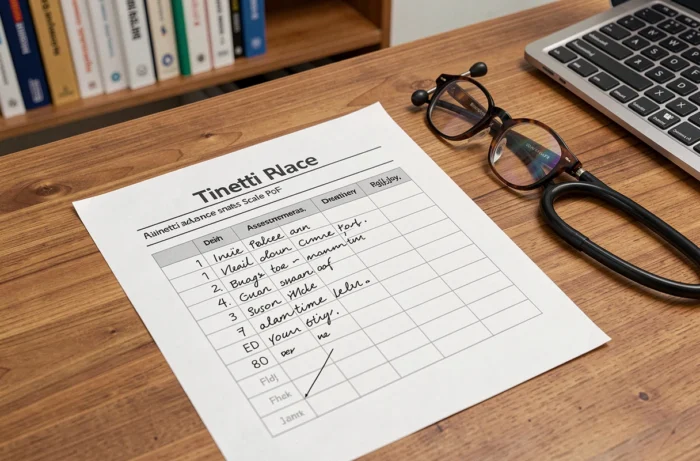
To have a structured form with the two sub-scales and detailed scoring, you can consult the Tinetti scale to print in PDF format, ready to be used in consultation.
Before printing, check that the document includes the following items in the balance section: sitting position, getting up from the chair, attempts to stand up, standing balance (first 5 seconds then prolonged), sternum push, eyes closed, 360-degree rotation, and return to sitting position. If an item is missing or if the scoring differs, you are not using the same version as your colleague, and your scores will not be comparable.
Tinetti score and fall risk: what the test really measures
It is often stated that a score below 20 out of 28 indicates a high risk of falling, and that between 19 and 24, the risk is moderate. These thresholds can be found on most downloadable PDFs. They pose a real problem of interpretation.
Recent literature reviews remind us that no balance test predicts falls on its own. At the classic threshold of less than 20, the sensitivity drops to around 0.45. In practical terms, more than one in two fallers slips through the cracks. Using the Tinetti as an automatic risk detector gives a false sense of security.
The Tinetti serves another purpose: to track the functional evolution of walking and balance over time. A patient who moves from 18 to 23 after a rehabilitation program shows measurable progress. A patient stable at 22 over three successive evaluations confirms the maintenance of their abilities.
Beware of the minimal detectable change
A gain of two or three points between two evaluations does not necessarily indicate a real improvement. Available data on the minimal detectable change (MDC) show that a variation of this order can fall within measurement noise for an individual patient, while the same difference averaged over a group becomes statistically significant in a clinical trial.
In practice, do not conclude progress on a difference of less than five points for an isolated patient. Note the testing conditions (time, fatigue, technical assistance used) on the printed form to be able to compare identical situations.
Administering the Tinetti test: three mistakes that skew the score
The PDF is not enough. The way the test is administered radically changes the result obtained.
- Changing versions between two evaluations. If the first scoring uses a 9-item form for balance and the second uses a 13-item form, the comparison makes no sense. Keep the same printed PDF from one session to another, or annotate the source of the document.
- Scoring gait in a corridor that is too short. The gait section requires observing step length, foot height, symmetry, and continuity. Over three meters, you see nothing. Plan for a corridor of at least eight to ten steps back and forth, with a regular surface.
- Not noting the technical assistance used. The test specifies that the patient walks with their usual aid (cane, walker). If you test without the aid and then with it, you obtain two different scores for the same functional ability. Always record the type of aid on the form.

Tinetti, TUG or Berg: which balance test to print first
The Tinetti is not the only tool available, and the choice depends on the evaluation context. The Timed Up and Go (TUG) measures the time needed to stand up, walk three meters, turn around, and sit back down. It takes less than a minute and only requires a stopwatch. For quick screening in the office, it is often more suitable.
The Berg scale (56 points, 14 items) offers a more detailed assessment of static and dynamic balance, but its administration takes about fifteen minutes and requires equipment (step stool, objects to pick up from the floor). In a rehabilitation setting, it complements the Tinetti well.
The Tinetti retains a specific advantage: it assesses both balance and gait in one tool, in about five minutes. For regular follow-up in nursing homes or at home, this combined format remains the most practical to print and fill out.
Integrating the Tinetti into a comprehensive fall assessment
Recent recommendations emphasize a multifactorial assessment of fall risk. The Tinetti score alone is not sufficient. It is combined with a review of medications (psychotropics, antihypertensives), a vision test, an evaluation of the home environment (rugs, lighting, bathroom), and a questionnaire on fear of falling such as the FES (Falls Efficacy Scale).
On the printed PDF, add a notes section at the bottom of the page to record these additional elements. A form that only includes the raw score without clinical context loses much of its utility during review, a few months later.
The Tinetti test remains a solid field tool for tracking walking and balance, provided that the same version is always used, the testing conditions are noted, and the score is never read as an isolated verdict on fall risk.