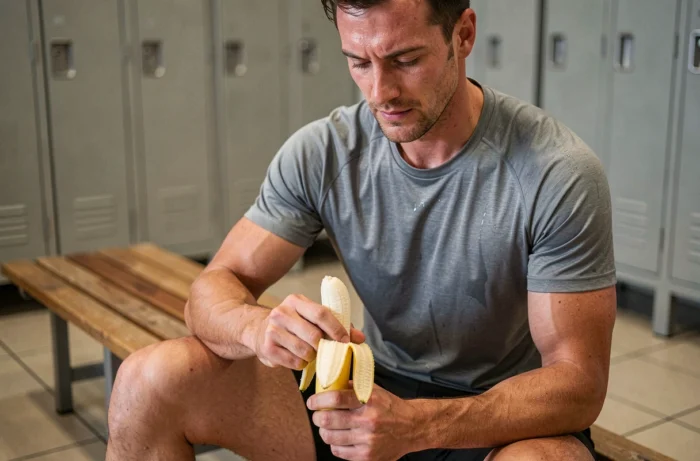
Between a still green banana and a speckled brown banana, the carbohydrate composition changes drastically. For an athlete, this parameter weighs more heavily than the choice between a Cavendish and an exotic variety. Understanding what happens at the level of ripeness and type of banana allows for adjusting energy intake at the right time, before, during, or after exertion.
Dessert banana, plantain banana, and mini-banana: a comparative table for sports
Not all bananas play the same role in a sports nutrition strategy. The plantain banana, typically consumed cooked as a starchy food, remains very high in starch when green. It is better suited for a structured meal several hours before exertion than for a quick snack on the field. The classic dessert banana (Cavendish type) and the mini-banana (Frécinette) are more suitable for on-the-go use.
| Type of banana | Consumption method | Dominant carbohydrate profile | Appropriate sports moment |
|---|---|---|---|
| Dessert banana (Cavendish) | Raw, at any stage of ripeness | Simple sugars if ripe, resistant starch if green | Before, during, or after exertion |
| Frécinette banana (mini-banana) | Raw, often well-ripened | Simple sugars, smaller portion | Light snack pre-effort or recovery |
| Plantain banana (green, cooked) | Cooked (sautéed, boiled) | High resistant starch | Pre-effort meal (2 to 3 hours before) |
A detailed guide on ideal bananas for sports on Bougez Chez Vous delves into this logic of varietal selection based on each discipline.
Glycemic index and ripeness: the real performance lever
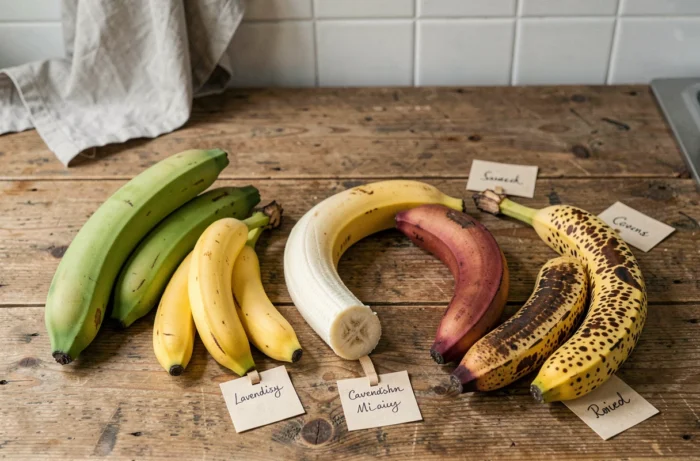
The distinction between varieties matters, but the degree of ripeness alters the glycemic response more than the varietal choice. An analysis published by Verywell Health in September 2026 documents a decrease in starch and fiber as ripening progresses, with a lower glycemic index for a slightly green banana than for a ripe banana.
Green or yellow banana: two different fuels
A slightly unripe banana contains more resistant starch. This starch is not digested in the small intestine: it leads to a gradual release of glucose into the blood. For a long endurance effort (cycling, trail running), this profile limits glycemic spikes followed by fatigue crashes.
Conversely, a well-ripened banana, with a speckled or slightly browned skin, provides readily available sugars. Rapid absorption is better suited during exertion or just before a start. In immediate recovery as well, these simple sugars accelerate the replenishment of glycogen stores.
- Green to pale yellow banana: snack 1.5 to 2 hours before a long effort, slow-releasing energy
- Well-ripened yellow banana: within 30 minutes before the start or during exertion, immediate energy
- Very ripe banana (brown spots): post-effort recovery window, rapid glycogen recharge
Peri-effort nutrition: adapting the banana to the type of training
A half-marathon runner and a weightlifter do not have the same carbohydrate needs at the same time. The choice of banana should be aligned with the duration and intensity of the effort rather than a one-size-fits-all rule.
Short, high-intensity efforts
For a weight training session or interval training, a ripe banana consumed about twenty minutes before the session provides a quick usable energy spike. The portion remains modest (a standard dessert banana). The goal is targeted glycogenic intake, not a meal.
Long efforts and endurance
For efforts exceeding an hour, the strategy changes. Ahead of time, a less ripe banana in a structured meal (combined with proteins and fats) provides a stable energy base. During exertion, a well-ripened banana, easy to chew and digest, effectively replaces an industrial energy gel.
Dried banana is an interesting alternative for ultra-endurance sports. Its high caloric density allows for transporting a lot of energy in a small volume. However, its residual fiber content can pose a digestive issue for some sensitive athletes during very long efforts.
Digestibility and practical limits according to athletic profiles
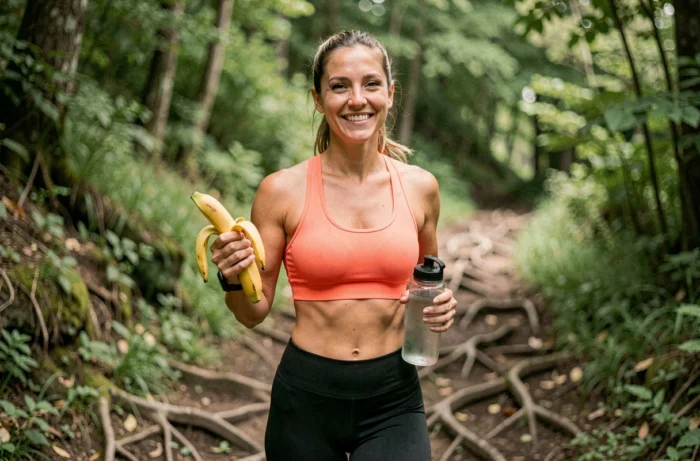
The banana is often presented as perfectly digestible. The reality depends on the individual profile. Some runners report bloating with a green banana consumed too close to the start, due to the resistant starch fermenting in the colon.
Digestive tolerance varies greatly from athlete to athlete. Testing each stage of ripeness during training, never in competition, remains the only reliable method to identify what works.
- Green banana: risk of bloating if consumed less than an hour before exertion
- Very ripe banana: well-tolerated by most, but can cause too sharp a glycemic spike in athletes sensitive to reactive hypoglycemia
- Cooked plantain banana: acceptable digestibility in a complete meal, unsuitable as a field snack
The banana does not cover all needs. It provides little protein and almost no fat. Pairing it with a protein source in recovery (yogurt, nuts) completes the nutritional profile and supports muscle repair.
The most actionable parameter remains ripeness, much more than the variety listed on the label. A pale yellow Cavendish and a Frécinette at the same ripening stage behave similarly in terms of glycemic response. Choosing your banana based on the timing of the effort and your own digestive tolerance yields more concrete results than searching for a miracle variety.