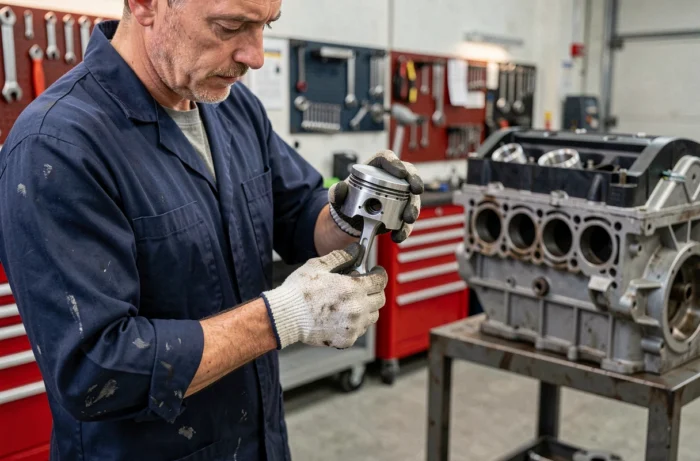
When talking about forged engines, the discussion often revolves around raw power and tuning. The technical reality is more nuanced: forging the internal parts (pistons, connecting rods, crankshaft) alters the metallurgical structure of the components, which changes their behavior under thermal and mechanical stress. The challenge remains to measure what this process concretely brings and what it costs in return.
Cast parts vs. forged parts: what metallurgy really changes
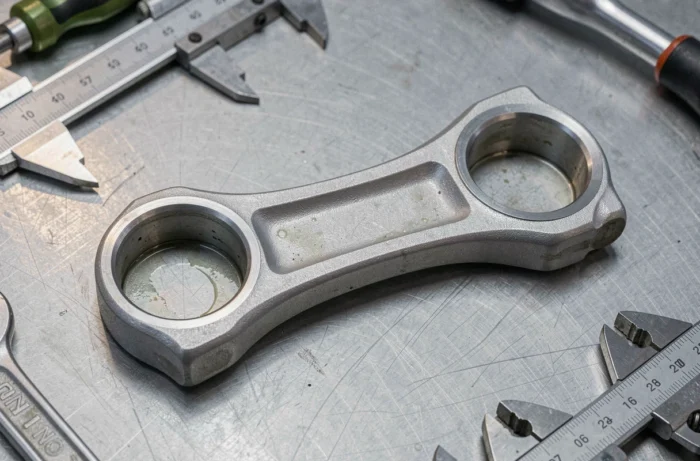
The difference between a cast part and a forged part is not just a matter of overall strength. Forging compresses the metal under high pressure, aligning the grains of the crystalline structure in a coherent direction. The result: a significantly higher fatigue resistance than that of a part cast in a mold.
A cast part retains internal micro-porosities, invisible to the eye, which become starting points for cracks under repeated stress. On a forged piston, these porosities are almost absent. The material density is homogeneous throughout the section.
| Criterion | Cast part | Forged part |
|---|---|---|
| Metallic structure | Non-oriented grains, micro-porosities | Aligned grains, homogeneous density |
| Fatigue resistance | Moderate | High |
| High temperature resistance | Possible deformation under prolonged load | Increased dimensional stability |
| Unit manufacturing cost | Low | Significantly higher |
| Weight at equal strength | Heavier (thick walls to compensate) | Lighter (optimized walls) |
| Typical use | Production engines, low load | Sport, industrial, modified engines |
This table highlights a point that online discussions often underestimate: at equal mechanical resistance, a forged component can be lighter than a cast component. Less mass in motion in the lower engine means a direct gain in inertia and the engine’s ability to rev up.
To better understand the advantages and disadvantages of a forged engine, one must go beyond the mere question of strength and examine the actual usage context of the vehicle.
Forged engine in series use: not just for tuning
The idea that the forged engine is exclusively intended for tuning or competition deserves correction. Several manufacturers integrate forged components directly into production engines under high load.
The case of the Caterpillar C32 ACERT is revealing. This industrial engine uses forged steel pistons with an integrated skirt, not to gain horsepower, but to withstand the pressures and temperatures associated with more efficient combustion. The result: reduced consumption and lower emissions, while remaining compliant with EPA Tier 2 and EU Stage II standards.
This detail changes the perspective. Forging is not just a luxury for tuners: it is a technical lever that the industry uses to balance power, longevity, and environmental compliance on blocks subjected to continuous stress.
Forged pistons on production sports cars
On the consumer automotive side, high-specific-power sports cars regularly come equipped with factory-forged pistons and connecting rods. The logic is the same: when the compression ratio increases or a turbo pushes the pressure beyond what a cast component can tolerate, forging becomes the default solution for engineering teams.
Manufacturing defects and failures: forged is not infallible
Associating “forged” with “unbreakable” would be a mistake. Recent feedback on certain engines shows that failures are often linked to manufacturing defects in the forged parts themselves, rather than a lack of theoretical material strength.
A documented case involves the General Motors V8 6.2 liters, which had ongoing issues after recalls related to internal failures. The forged part offers superior strength potential, but this potential is only realized if quality control is rigorous at every stage: heat treatment, shot peening, machining tolerances.
- A poorly calibrated heat treatment can create internal stresses in the forged part, negating the benefits of forging
- Pre-stress shot peening, which improves surface fatigue resistance, must be applied with precise parameters to avoid weakening the part
- Machining tolerances on a forged crankshaft or connecting rod are tighter than on a cast part, making the manufacturing process more sensitive to errors
In other words, the quality of a forged engine depends as much on the manufacturing process as on the choice of material. A forged piston made with poor quality control will be less reliable than a cast piston produced under controlled industrial conditions.
Real cost of a forged engine: beyond the price of parts
The additional cost of a kit of forged components compared to cast parts is known. However, the overall cost of converting to a forged engine far exceeds the price of the connecting rods and pistons.
- Dynamic balancing of the lower engine is mandatory after replacing the internal parts, adding several hours of specialized labor
- Recalibrating the electronic management (injection mapping, ignition) is necessary if the mass or compression characteristics change
- Peripheral components (gaskets, rings, bearings) must be replaced simultaneously to ensure the reliability of the whole
- A specific break-in, longer than on a standard engine, conditions the longevity of the forged parts
The total budget for a forged conversion often represents double the cost of the parts alone. Failing to include these items in the calculation leads to disappointments, especially when a “budget” forged engine fails due to a lack of balancing or recalibration.
Durability and return on investment
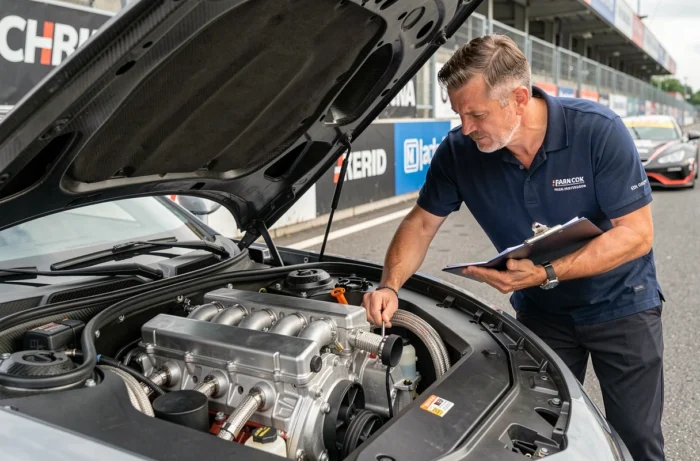
On a vehicle used in competition or subjected to regular track sessions, the investment is justified by the reduced risk of engine failure. On a road car used under normal conditions, the gain in durability remains marginal compared to the additional cost incurred.
The factor that guides the decision is neither the targeted power nor the prestige of forging. It is the actual usage regime of the engine: an engine that never exceeds its factory limits gains no measurable benefit from forging. The choice is justified only when mechanical stresses exceed what the original components are designed to withstand.